
Monthly Archives: February 2015

Breaking Camp(s)

breaking camp

From his 2001 book GodViews: Convictions that Drive and Divide Us, Jack Haberer arrives into 2015 as a prophet.   The fourteen year old book is a call to attend to denominational differences that, today, are brimming over.  The book is relevant and powerful. On March 1st from 4-6 p.m. we will be reviewing the book as we prepare to discuss proposed amendment changes to our denomination’s constitution on Thursday March 5th at 7 p.m.  Our Presbytery, Grace, votes on those amendments on its Saturday meeting scheduled for March 7th.

In the beginning of his book, Haberer notes the dynamics, or lack there of, found in binary thinking.  Not unlike the dominant two party system of our national government, folks in America are prone to binary thinking.  It’s “us” or “them” on any number of matters.  This, Haberer notes, is true in our denominational culture as well. In fact, he remembers an action of the 2000 General Assembly, the national gathering of our denomination.  This action, initiated by Evangelical Christians within our denomination sought to declare an impasse.  The impasse was understood to have been created by contrasting theological and ethical beliefs between two camps within our denomination, “liberals” and “conservatives”.  The proposed resolution to the impasse was that “liberals” might leave the denomination. Ironically and sadly, today, we have witnessed a exodus of the church, not of “liberal voices” but of “conservative voices”.

The question is still clearly before us, “Is our denomination, PC(USA) at an impasse in terms of theology and ethics? How will a perceived impasse affect our local congregations?  Haberer encourages our questions but challenges the idea of impasse in the following ways:

  1. The idea of an impasse declares “…that today’s church is much more divided than were churches in the apostolic era…” (24, GodViews).  When, in fact, the evidence is that divisions plagued the ancient church in places like Corinth.(1 Corinthians 1:13).
  2. The thesis of the impasse was “that some believe that ‘the Bible is accurate and the Word of God speaks to entire Church with absolute authority.’ while others believe that ‘biblical authority is determined by personal feelings or various academic disciplines.'” (26)  Haberer notes that most all Christians have preferred selections of scripture and that most all Christians appreciate the academy’s informing influence upon our texts.
  3. The impasse goes too far in characterizing camps of people.  One camp might be characterized by theological grounding in the Five Solae of the Protestant Reformation.  The other camp might be characterized by the ethics of love and justice as proclaimed by Jesus and the prophets.  Haberer asks us, if these two camps can be successfully excluded from one another and faithfully reflect the Gospel of Jesus Christ?
  4. Finally, Haberer notes that two party thinking not only contributes to gross oversimplifications but it also paralyzes “the very communication that could help correct misrepresentations.” (26)

We gather on March 1st to more fully consider the way that Haberer suggests we understand one another in order to move beyond paralysis.  This will be a fun and interactive meeting with an purpose around our ultimate concerns.  Is our denomination forever lopsided toward one camp or the other?  Does our denomination leave no room for a multiplicity of voices to be heard with integrity?

godviews

Let’s break camp(s) and move into Haberer’s spacious and  gracious society of GodViews.  Bring a friend, you will be glad you did.

1 Comment

Filed under Uncategorized

Report of Our First Gathering

Thirty  individuals arrived to our first discussion of denominational issues.  The discussion was supported by a Ruling Elder, Julie Wells who served as a subject matter expert in the area of General Assembly.   We were further supported by attorney, professional mediator, and Ruling Elder at First Pres, John Palmer.  This initial discussion enjoyed a positive and respectful tone.  After all, we would expect nothing less at First Presbyterian!  There were honest comments with enough candor and humor to make us feel like we were involved in a real conversation.

We covered questions regarding Presbyterian process and decisions about divestment from companies involved in the Israeli/Palestinian conflict.   Concerns shared included:

  •  a concern that the denomination was tilting toward a liberal orientation
  • a concern that there is a lack of unity in the larger church
  • a concern for a continued commitment to the Reformed Tradition in which we those with whom we disagree with kindness and respect. A word is missing here??
  • a concern to stay, talk, learn, vote and find consensus

On the whole, the group seemed to be counseling togetherness to one another.

At the conclusion of our time, there was some question about meeting for subsequent gatherings.   There was enough interest that we will gather again on March 1st and March 5th.    Here is what one can expect at those gatherings.

March 1st will be a gathering from 4-6 p.m. in the church Fellowship Hall.

After receiving an overview of the book Godviews, we will discuss the various Godviews and their interdependence.  This lays the foundation for March 5th.  An intent to attend both  March 1st and 5th will benefit our process greatly.

March 5th will be a guided discussion on the redefinition of marriage.  This has been a discussion that some approach with fear and trembling. Because we are not in the business to persuade one another away from our opinions, the March 5th discussion will be an opportunity to listen to others, practice speaking and to engage prayer as we deepen our discipleship.

Our presbytery, Grace, votes on amendments,  at its  March 7th meeting.  We will be sure there is a congregational gathering to report the results of that vote and to have some conversation as a larger body as well.  Stay tuned for the date and time of that congregational gathering.

I will be posting in the days to come as we prepare for the March 1st meeting.  It would be great to fill Fellowship Hall with 100 folks.  Small group work alternated with large group conversation may  help us, as a March 1st  congregational  microcosm,  to imagine congregational sentiment at the macro level.

Leave a comment

Filed under Uncategorized

What are you hoping for? Leave a comment.

listening

As we prepare for Thursday night, we hope to learn what participants will want to learn.  If you are planning on attending the event and have a specific hope, it would be great to leave a comment here.  All comments have to be approved to be posted.  So if you would prefer that your comment be private, simply say so.  We will take it as information for our preparation but we will not post it.  If you are comfortable with your hope being posted, it may help others clarify their own hopes for the gathering.

Some possible hopes that have been expressed to me include:

  • better understanding of where we are in the Presbyterian process after General Assembly.
  • more/better information on the decisions of the 221st General Assembly.
  • a safe environment to talk about how I am feeling about our denomination
  • steps toward making some sort of response to our larger denominational governance
  • a greater understanding of what my fellow First Presbyterian church members think and feel

These, of course, are just a few and surely do not cover all the hopes.  Thanks for helping us prepare.

1 Comment

Filed under Uncategorized

Learning to Talk

“When I was a child I spoke like a child, I thought like a child, I reasoned like a child;  when I became an adult, I put and end to childish ways.”  1 Corinthians 13:11

talking practice

For the Apostle Paul there is a continuing maturation of the believer as the Kingdom of God comes into its fullness.  Paul’s calls upon the Corinthian community to exercise themselves toward a unity in the midst of distinctions.   This is a challenging call.  Sometimes unity is easy.  As a church family, we come together to share meals.  We come together to celebrate a wedding, a funeral, a confirmation or a baptism.  We join in Sunday morning worship sharing in our hymns, prayers and confessions.  All of these are part of coming together and exercising unity.  However, sometimes unity is not so ritualized or even easy.

Think back upon the children you have known.  Some of them spoke early, some of them spoke late but all of them learned to speak by practicing.  When human beings are young, we do not expect them to speak perfectly.  We know that their good speech requires practice and practice happens best with others.  At their youngest, we ask children to simply repeat us.  Gradually, they begin to decide which words to use.  Words become sentences and sentences become opinions and conversations.   In this way, the speech practice of infancy continues into adulthood.

When unity is not easy, we can return to the idea of practicing our speech.  Paul is brilliant in his illustration.  In speaking to adults, he uses himself as an example a person in process. He calls upon the community’s memory of their own journey of maturation.  He invites them to understand that the journey of maturation continues.  He invites us to this same awareness during times when distinctions are painfully present and yet the call of unity is upon us.

As the world changes around us, we are challenged to continue to practice our speaking.  What, was once, management of our tongue and facial muscles to make the right sounds,  becomes attention to the mind, logic, emotion and meaning behind our words.  We practice talking in order to practice what we mean.   This still happens most powerfully within loving and respectful communities.  So when we come together to talk about life’s meaning, what we need most is patient listening, questions and a community that seeks understanding.

This is what next Thursday night is about.  We will practice articulating what our denominational decisions mean for us.  We will not always say exactly what we mean and we will have to try again.  But in an environment of listening, clarifying questions and striving to understand one another, I trust the Kingdom will emerge for us particularly.  I trust we will begin to perceive our way forward.  For all these reasons, I hope you will join us.

Leave a comment

Filed under Uncategorized

When our minds aren’t one….

images

As long as our hearts are one in Christ, our minds don’t have to be.  This is a favorite way to voice our congregation’s self-understanding at First Presbyterian Church of Waco.  It helps us to  hold and honor a variety of opinions within a particular part of the Body of Christ.  We, at First Presbyterian have allowed this self-understanding to both comfort and challenge our mindset.  In challenging times, it is our ability to hold this phrase like a prayer that allows us to mindfully attend our individual hearts and minds.  Because passions and reasoning can overlap and run together, it is this particular congregational prayer that allows us to take time with the heart and mind separately when its necessary to do so.

The heart, in this prayerful statement, is not referencing an organ in our individual bodies. It is that a more spiritual seat of passion and emotion.   In fact, here the heart, here, is imagined as an emotional/spiritual front line receiving our passions. Passions arrive to the heart even before we reason through them.  This spiritual and emotional front line can be the place we feel our anxiety and our grief well up.  It can be the place from which we cry out, something like,  “My heart just aches over this.”  The heart, in this way, is a bubbling spring of passion and feeling.  It messages and appeals to the brain, “Let’s make some sense of what we are experiencing.”

If you could separate the concerns of your heart and your mind regarding our denomination’s decisions, how would you describe your heart’s concerns?

If your heart has been hurting in the wake of the General Assembly’s votes and actions, how might you rate the degree of your discomfort or even agony?

In the wake of the votes and actions, how much of your heart’s concerns relate to your personal values?  How much relates to the effect that the vote has had upon the wider church?

These questions are not the only ones. Perhaps they will help you find your better questions.   I hope you will join in discussion at our gathering on February 12th at 7:00 p.m.  Note the time change.

Leave a comment

Filed under Uncategorized

Assemblies after the General Assembly

general assembly 2

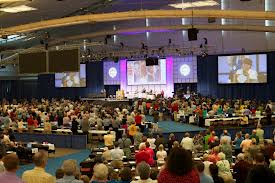
A picture of the assembly of commissioners to the 221st General Assembly in Detroit Michigan.

This blog on denominational issues requires a brief history of its purpose.

Prior to June of 2014 and the 221st General Assembly, the pastoral staff of First Presbyterian was engaged with our local Jewish Rabbis regarding the upcoming General Assembly.  There was a great deal of anticipation regarding the PCUSA’s decisions at the Assembly.

The conversations continued following the assembly.  First Presbyterian Church of Waco met as a congregation in late June of 2014 to debrief the assembly.  Additionally, the pastoral staff hosted one other small group gathering.  We  met with local Jewish brothers and sisters and interested members of the congregation.  Finally, as individuals requested private appointments, we honored those also.    All of these were opportunities to share, what, was then, recent information from the 221st General Assembly.

The session of First Presbyterian took up the discussion in two of its meetings in the summer of 2014.  Though they took no formal action, they remain attuned.   Your leadership is ready to listen, learn and lead in a way that strengthens First Presbyterian.  Each stewardship season, there is the opportunity to make comments about what we hope for our local congregation in the coming year. A number of congregants took the opportunity to share their continued concern regarding denominational decisions.    Such consistent and long standing concerns certainly suggests that additional forums for conversation are necessary.

pc-biz.org is still a website where you can find voting history and rationale for the votes from the 221st General Assembly should that be helpful for you.

So, the vision for this blog and the four face-to-face conversations throughout February and March is to honor one another in the act of listening.  Perhaps in we can grow in our understanding together.  We appreciate your prayers as we move forward toward the Lenten season and the ultimate hope of our Christian community.

Leave a comment

Filed under Uncategorized