We confess easily, in this Lenten season, that Christ suffered and died. With various understandings of atonement emphasized, we confess it easily because we understand that Christ’s suffering brings us at-one with our Creator. What is more difficult, is that suffering is also required of me as an individual person of faith. I suffer to know how to respond to a weary world with faithfulness. I suffer to know how to meet the needs of my neighbors, enemies and friends. I suffer when congregations experience loss or become disoriented. I suffer when my denomination engages their process of discernment. And my denomination engages their spiritual practice of discernment with rigorous regularity.
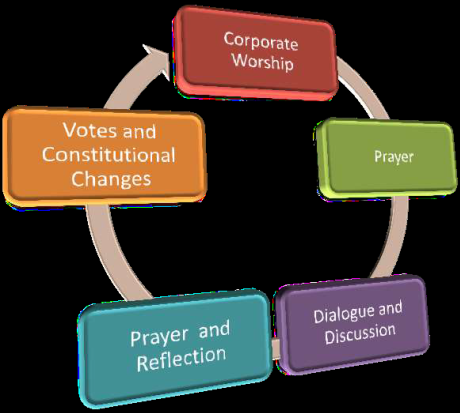
This process of discernment is not for the faint of heart. Though it might be imagined many ways, as pictured above, our discernment begins in worship where we are illumined by scripture and tradition with the help of the Holy Spirit. Worship, then, informs our awareness giving rise to the organic and constructed prayers of day life. In dialogue and discussion, worship and prayer arrive to particular moments of awakening and consternation within the wider world. These conversations engaged with intention (or the ones that we simply overhear), lead us again into prayer and reflection. All of this a preparation for the votes that Presbyterians do to acknowledge their simple and super majorities and also their minorities. Minorities and majorities then return to worship together, giving themselves, again to work of the Spirit.
Yesterday was another day of voting with in the privileged agony of being Presbyterian. Throughout three decades of discernment, our denomination worshiped, prayed, discussed, prayed, voted and returned to worship around the subject of human sexuality. Insistent returns to this cycle confess we will not be rushed nor will we be inert. For many, even of differing points of view, it was an important day. Some celebrated and jumped to their feet in praise. Others sat with quiet stillness, reading or listening to the news. Our attention focused on the decision to change the definition of marriage, traditionally understood between a man and a woman, to an understanding of marriage between two people.
A portion of Christ’s greatest suffering was among three leading disciples in the garden who could not keep vigil with him. Knowing the story of Gethsemane, we strive for vigilance. It requires our ability to stay awake and abide within the agony of our discernment process. A vote does not a denomination make. I have reminded myself of that over the last three decades. But votes do ask us to mark and continue our journey. Votes show us the state of our denomination so that we may worship, pray and engage one another with vigilant love. It is the work within the agonizing cycle of discernment that allows a denomination to build momentum. It is momentum that allows for intentional spinning outward toward a dynamic and waiting world. The disciples found their vigilance in the midst of suffering so, perhaps, we will as well. Such is the community that follows The One who was undeterred by certainty, uncertainty, and suffering. In his suffering we are made whole. Let us not take that tension lightly.
T


 Waco Pastor