Category Archives: Uncategorized

Cooking Up Liturgy

There is a strong argument to be made for hand-prepared, proximate food. Preparing and cooking up our own food has a powerful effect on nutrients, energy and sometimes even well-being. There is always an option to acquire food made some distance from our tables….made by other hands….other bundles of energy.

There is a similar and equally strong argument for liturgy that is written and offered in local congregations. Determining vocabulary key words, refrains and pace of content contributes to the energy of a worship service and maybe even the well-being of congregants within that worship service. There is always an option to acquire prayers and liturgy from published sources. And while those resources are excellent catalysts for our own creative efforts, they are a different and distant bundle of energy.

Whether preparing food or liturgy, the preparation can feel overwhelming. Here are some steps in the adventure and process that I enjoy each week when writing liturgy for the congregation in Waco. What do you enjoy when cooking up your liturgy?

Liturgy As Adventure and Process (not necessarily a linear process)

  1. Identify worship theme.  The more a theme is anchored to an archetype, the more feeders the theme will have.   A theme is often derived from anyone of the following
  2. Sermon series
  3. Scripture passages
  4. Liturgical calendar
  5. Current events
  • Assess theme and its feeder ideas for any unnecessary constriction or restriction often found in negative assumptions about the people in the pews.    Negative assumptions can impact liturgy in ways that paradox people from deeper prayer and reflection. 
  • Build a vocabulary cache of experience-related key words relevant to the theme.  For example if the theme is wisdom experience based key words: ah-ha moment, memorization, rote learning, trial and error, mentor, student, classroom etc.
  • Consider progression of experience within liturgy toward the theme that culminates in sermon or sacramental moment.   On that same theme of wisdom, consider a progression from rote learning toward trial and error….toward ah-ha. 
  • Drafting prayers or affirmations that use active experienced-based verbs that are coupled with more esoteric or conceptual doctrinal ideas.  Arranging the drafts with appropriate tension as a foreshadowing of the work that often happens in the sermons.  Example: the theme of wisdom is full of the tension between what is known and not yet known  (emerging) or may never be known.  The kingdom as “here” and “not yet”.

Refining the drafted liturgy for the oral experience and for final expulsion of unnecessary constriction and restriction.  Assuring there is space for memory and imagination in the liturgy.
Leave a comment

Filed under Uncategorized

Votes and Vigilance…in other words the agony of discernment

process of discernment

We confess easily, in this Lenten season, that Christ suffered and died.  With various understandings of atonement emphasized,  we confess it easily because we understand that Christ’s suffering brings us at-one with our Creator.  What is more difficult,  is that suffering is also required of me as an individual person of faith.  I suffer to know how to respond to a weary world with faithfulness.  I suffer to know how to meet the needs of my neighbors, enemies and friends.  I suffer when congregations experience loss or become disoriented.    I suffer when my denomination engages their process of discernment. And my denomination engages their spiritual practice of discernment with rigorous regularity.

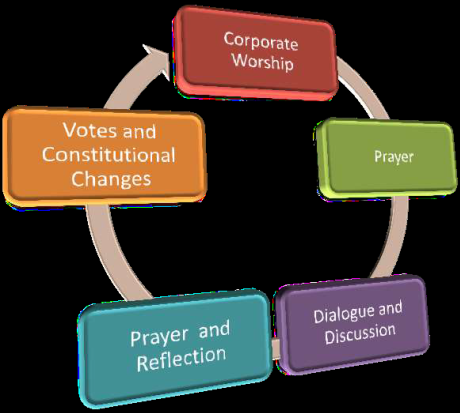
This process of discernment is not for the faint of heart. Though it might be imagined many ways, as pictured above, our discernment begins in worship where we are illumined by scripture and tradition with the help of the Holy Spirit.    Worship, then, informs our awareness giving rise to  the organic and constructed prayers of day life.   In dialogue and discussion, worship and prayer arrive to particular moments of awakening and consternation within the wider world.    These conversations engaged with intention (or the ones that we simply overhear), lead us again into prayer and reflection.  All of this a preparation for the votes that Presbyterians do to acknowledge their simple and super majorities and also their minorities.  Minorities and majorities then return to worship together, giving themselves, again to work of the Spirit.

Yesterday was another day of voting with in the privileged agony of being Presbyterian.  Throughout three decades of discernment, our denomination worshiped, prayed, discussed, prayed, voted and returned to worship around the subject of human sexuality.  Insistent returns to this cycle confess we will not be rushed nor will we be inert.  For many, even of differing points of view, it was an important day.  Some celebrated and jumped to their feet in praise.  Others sat with quiet stillness, reading or listening to the news.  Our attention focused on the decision to change the definition of marriage, traditionally understood between a man and a woman, to an understanding of marriage between two people.

A portion of Christ’s greatest suffering was among three leading disciples in the garden who could not keep vigil with him.  Knowing the story of Gethsemane, we strive for vigilance.  It requires our ability to stay awake and abide within the agony of our discernment process.  A vote does not a denomination make. I have reminded myself of that over the last three decades.  But votes do ask us to mark and continue our journey. Votes  show us the state of our denomination so that we may worship, pray and engage one another with vigilant love.  It is the work within the agonizing cycle of discernment that allows a denomination to build momentum.  It is momentum that allows for intentional spinning outward toward a dynamic and waiting world.  The disciples found their vigilance in the midst of suffering so, perhaps, we will as well. Such is the community that follows The One who was undeterred by certainty, uncertainty, and suffering.  In his suffering we are made whole. Let us not take that tension lightly.

T

3 Comments

Filed under Uncategorized

Where I Stand

stand by me

Increasingly, I am humbled by a truth.  The truth is that where I stand, my perspectives, my religious beliefs, and my personal convictions within those religious beliefs are, in important ways, beyond my reasoned control.  I have moments when I rage in argument against “the other side” or perspective.  There are moments of frustration or even competitive despair.  But I have noticed that I used to do more raging, I had more frustration and despair in the past than I do these days.  Perhaps I am just getting older.

Increasingly my frustration and raging are replaced by a fascination with “the other side”.  “The other side” of opinions, beliefs or inclinations does not always persuade me.  For that reason, the fascination is strange.  The fascination leaves me in a strange place.  Even as I cannot control my perspectives or opinions, I find that I cannot help, at this point in my life, being so interested in the space between two arguments.

I stand, in the space between two arguments and on either side, I see individuals of such complexity and sensitivity that it sends me to a mystical place of contemplation.  In that place of contemplation, there is a wish that each person could be recognized for their depth and celebrated for their particularity.  The wish continues that no one would have to suffer.

Yet arguing and suffering are sure parts of the human experience. As they are unavoidable, suffering is the common experience to greater or lesser extent on both sides of an argument.  How romantic it would be to be a revolutionary, a prophet even an activist!  There are others who are carrying this energy well and I have to admit that I am  a bit jealous.  I believe that activist energy is part of who I am.  But I stand in a primary energy that is quite different.

The energy is something like a leveraged pull.  From the foothold of Reformed Christianity, I pull on polarities to see how long a  venn of relationship might hold the overlap.  Some of the overlap is generous, some is imperceptibly slight.   But sometimes, in the acquaintance, those on two sides of an argument remember and find their way back to the venn.

2 Comments

Filed under Uncategorized

Interdependence Day

texas independence

On the day we celebrate the rich history of Texas and its independence, I thought I might take a little time to celebrate some great interdependence.  Last night almost 40 congregants arrived to the Fellowship Hall of First Presbyterian Church in Waco in order to discuss Jack Haberer’s book GodViews.  Haberer provides a wonderful tour through the various types  of Theo-Ideological Impulses (34)….or for simplicity’s sake, GodViews.  These GodViews describe at least five ways that individuals perceive God’s call upon their lives.  Here is the briefest summary:

  1. The Confessionalist is an individual who understands, through careful attention to the scriptures, a truth that must be proclaimed, shared and protected.
  2. The Devotionalist is an individual who understands that prayer, contemplation and quiet time with God is an essential expression of faith.
  3. The Ecclesialist is an individual who understands the building of the local church and its ecumenical relationships to be what God calls them to do .
  4. The Altruist is an individual who perceives the call to help the “least among us” and to respond to God’s call by “feeding His sheep”.
  5. The Activist is an individual who understand that God’s call upon their lives is to participate in social transformation, breaking down systemic evils to realize peace, justice and mercy.

In his nuanced and sympathetic approach, articulating our distinctions,  Haberer pushes further.  Even existing within a a similiar GodView does not mean that you will share a same mind or opinion.  There can be, within each GodView, sharp disagreements.  If any GodView lives alone too long, there may be a propensity to self destruct.  The Confessionalist becomes Judgmentalist.  The Devotionalist becomes an Isolationist.  The Altruist becomes a sort of Secularist.  The Activst morphs into an Elitist.  Lest we secede from one another, Haberer seals his effort with an argument for interdependence, stating that that no one GodView can exist well or mature to its finer place without influence of all the others.

The participants in last night’s gathering knew this well and instinctively.  Again and again as they sat in the GodView “most indicative of them”, they could recognize good friends who were better indicated by a different GodView across the room.  Many voices rose up to identify friendships in those other GodViews.  One person declared, “Our parts make us whole!” Another remarked, “When we are cognizant of each GodView, we are less likely to be blindsided by our own thinking, believing and behavior.”   Finally, another said, “We all need each other even when we disagree.”

Today, Texas celebrates its historic courage in declaring its independence.  Then in its young and formative years, we might imagine the state as we do a young person, bravely differentiating in order to become a strong adult.  Today, our state is no longer young but well into its adulthood.  We celebrate the historic move to declare independence even as we strive to be interdependent in the USA today.  In the passage of time, there is a celebrate of our distinctiveness as a state and our place among the many.  So, too, in the maturation of faith.

We each, having necessarily distinguished ourselves from one another, bring our strength back to task of mission, ministry and Christian Education that we might be radically interdependent.  What a privilege it was to watch a portion of the congregation do their work last night.  Together they laid a strong foundation for more difficult conversations.  Our next gathering, on Thursday March 5th at 7:00 p.m.,  will discuss the marriage amendment to our Directory of Worship. The demands of healthy marriage require that the work of individuation has been completed.  A healthy marriage requires radical interdependence.  This may be true whether we are doing marriage as individuals or talking about marriage as the Body of Christ.

Leave a comment

Filed under Uncategorized

Breaking Camp(s)

breaking camp

From his 2001 book GodViews: Convictions that Drive and Divide Us, Jack Haberer arrives into 2015 as a prophet.   The fourteen year old book is a call to attend to denominational differences that, today, are brimming over.  The book is relevant and powerful. On March 1st from 4-6 p.m. we will be reviewing the book as we prepare to discuss proposed amendment changes to our denomination’s constitution on Thursday March 5th at 7 p.m.  Our Presbytery, Grace, votes on those amendments on its Saturday meeting scheduled for March 7th.

In the beginning of his book, Haberer notes the dynamics, or lack there of, found in binary thinking.  Not unlike the dominant two party system of our national government, folks in America are prone to binary thinking.  It’s “us” or “them” on any number of matters.  This, Haberer notes, is true in our denominational culture as well. In fact, he remembers an action of the 2000 General Assembly, the national gathering of our denomination.  This action, initiated by Evangelical Christians within our denomination sought to declare an impasse.  The impasse was understood to have been created by contrasting theological and ethical beliefs between two camps within our denomination, “liberals” and “conservatives”.  The proposed resolution to the impasse was that “liberals” might leave the denomination. Ironically and sadly, today, we have witnessed a exodus of the church, not of “liberal voices” but of “conservative voices”.

The question is still clearly before us, “Is our denomination, PC(USA) at an impasse in terms of theology and ethics? How will a perceived impasse affect our local congregations?  Haberer encourages our questions but challenges the idea of impasse in the following ways:

  1. The idea of an impasse declares “…that today’s church is much more divided than were churches in the apostolic era…” (24, GodViews).  When, in fact, the evidence is that divisions plagued the ancient church in places like Corinth.(1 Corinthians 1:13).
  2. The thesis of the impasse was “that some believe that ‘the Bible is accurate and the Word of God speaks to entire Church with absolute authority.’ while others believe that ‘biblical authority is determined by personal feelings or various academic disciplines.'” (26)  Haberer notes that most all Christians have preferred selections of scripture and that most all Christians appreciate the academy’s informing influence upon our texts.
  3. The impasse goes too far in characterizing camps of people.  One camp might be characterized by theological grounding in the Five Solae of the Protestant Reformation.  The other camp might be characterized by the ethics of love and justice as proclaimed by Jesus and the prophets.  Haberer asks us, if these two camps can be successfully excluded from one another and faithfully reflect the Gospel of Jesus Christ?
  4. Finally, Haberer notes that two party thinking not only contributes to gross oversimplifications but it also paralyzes “the very communication that could help correct misrepresentations.” (26)

We gather on March 1st to more fully consider the way that Haberer suggests we understand one another in order to move beyond paralysis.  This will be a fun and interactive meeting with an purpose around our ultimate concerns.  Is our denomination forever lopsided toward one camp or the other?  Does our denomination leave no room for a multiplicity of voices to be heard with integrity?

godviews

Let’s break camp(s) and move into Haberer’s spacious and  gracious society of GodViews.  Bring a friend, you will be glad you did.

1 Comment

Filed under Uncategorized

Report of Our First Gathering

Thirty  individuals arrived to our first discussion of denominational issues.  The discussion was supported by a Ruling Elder, Julie Wells who served as a subject matter expert in the area of General Assembly.   We were further supported by attorney, professional mediator, and Ruling Elder at First Pres, John Palmer.  This initial discussion enjoyed a positive and respectful tone.  After all, we would expect nothing less at First Presbyterian!  There were honest comments with enough candor and humor to make us feel like we were involved in a real conversation.

We covered questions regarding Presbyterian process and decisions about divestment from companies involved in the Israeli/Palestinian conflict.   Concerns shared included:

  •  a concern that the denomination was tilting toward a liberal orientation
  • a concern that there is a lack of unity in the larger church
  • a concern for a continued commitment to the Reformed Tradition in which we those with whom we disagree with kindness and respect. A word is missing here??
  • a concern to stay, talk, learn, vote and find consensus

On the whole, the group seemed to be counseling togetherness to one another.

At the conclusion of our time, there was some question about meeting for subsequent gatherings.   There was enough interest that we will gather again on March 1st and March 5th.    Here is what one can expect at those gatherings.

March 1st will be a gathering from 4-6 p.m. in the church Fellowship Hall.

After receiving an overview of the book Godviews, we will discuss the various Godviews and their interdependence.  This lays the foundation for March 5th.  An intent to attend both  March 1st and 5th will benefit our process greatly.

March 5th will be a guided discussion on the redefinition of marriage.  This has been a discussion that some approach with fear and trembling. Because we are not in the business to persuade one another away from our opinions, the March 5th discussion will be an opportunity to listen to others, practice speaking and to engage prayer as we deepen our discipleship.

Our presbytery, Grace, votes on amendments,  at its  March 7th meeting.  We will be sure there is a congregational gathering to report the results of that vote and to have some conversation as a larger body as well.  Stay tuned for the date and time of that congregational gathering.

I will be posting in the days to come as we prepare for the March 1st meeting.  It would be great to fill Fellowship Hall with 100 folks.  Small group work alternated with large group conversation may  help us, as a March 1st  congregational  microcosm,  to imagine congregational sentiment at the macro level.

Leave a comment

Filed under Uncategorized

What are you hoping for? Leave a comment.

listening

As we prepare for Thursday night, we hope to learn what participants will want to learn.  If you are planning on attending the event and have a specific hope, it would be great to leave a comment here.  All comments have to be approved to be posted.  So if you would prefer that your comment be private, simply say so.  We will take it as information for our preparation but we will not post it.  If you are comfortable with your hope being posted, it may help others clarify their own hopes for the gathering.

Some possible hopes that have been expressed to me include:

  • better understanding of where we are in the Presbyterian process after General Assembly.
  • more/better information on the decisions of the 221st General Assembly.
  • a safe environment to talk about how I am feeling about our denomination
  • steps toward making some sort of response to our larger denominational governance
  • a greater understanding of what my fellow First Presbyterian church members think and feel

These, of course, are just a few and surely do not cover all the hopes.  Thanks for helping us prepare.

1 Comment

Filed under Uncategorized

Learning to Talk

“When I was a child I spoke like a child, I thought like a child, I reasoned like a child;  when I became an adult, I put and end to childish ways.”  1 Corinthians 13:11

talking practice

For the Apostle Paul there is a continuing maturation of the believer as the Kingdom of God comes into its fullness.  Paul’s calls upon the Corinthian community to exercise themselves toward a unity in the midst of distinctions.   This is a challenging call.  Sometimes unity is easy.  As a church family, we come together to share meals.  We come together to celebrate a wedding, a funeral, a confirmation or a baptism.  We join in Sunday morning worship sharing in our hymns, prayers and confessions.  All of these are part of coming together and exercising unity.  However, sometimes unity is not so ritualized or even easy.

Think back upon the children you have known.  Some of them spoke early, some of them spoke late but all of them learned to speak by practicing.  When human beings are young, we do not expect them to speak perfectly.  We know that their good speech requires practice and practice happens best with others.  At their youngest, we ask children to simply repeat us.  Gradually, they begin to decide which words to use.  Words become sentences and sentences become opinions and conversations.   In this way, the speech practice of infancy continues into adulthood.

When unity is not easy, we can return to the idea of practicing our speech.  Paul is brilliant in his illustration.  In speaking to adults, he uses himself as an example a person in process. He calls upon the community’s memory of their own journey of maturation.  He invites them to understand that the journey of maturation continues.  He invites us to this same awareness during times when distinctions are painfully present and yet the call of unity is upon us.

As the world changes around us, we are challenged to continue to practice our speaking.  What, was once, management of our tongue and facial muscles to make the right sounds,  becomes attention to the mind, logic, emotion and meaning behind our words.  We practice talking in order to practice what we mean.   This still happens most powerfully within loving and respectful communities.  So when we come together to talk about life’s meaning, what we need most is patient listening, questions and a community that seeks understanding.

This is what next Thursday night is about.  We will practice articulating what our denominational decisions mean for us.  We will not always say exactly what we mean and we will have to try again.  But in an environment of listening, clarifying questions and striving to understand one another, I trust the Kingdom will emerge for us particularly.  I trust we will begin to perceive our way forward.  For all these reasons, I hope you will join us.

Leave a comment

Filed under Uncategorized

When our minds aren’t one….

images

As long as our hearts are one in Christ, our minds don’t have to be.  This is a favorite way to voice our congregation’s self-understanding at First Presbyterian Church of Waco.  It helps us to  hold and honor a variety of opinions within a particular part of the Body of Christ.  We, at First Presbyterian have allowed this self-understanding to both comfort and challenge our mindset.  In challenging times, it is our ability to hold this phrase like a prayer that allows us to mindfully attend our individual hearts and minds.  Because passions and reasoning can overlap and run together, it is this particular congregational prayer that allows us to take time with the heart and mind separately when its necessary to do so.

The heart, in this prayerful statement, is not referencing an organ in our individual bodies. It is that a more spiritual seat of passion and emotion.   In fact, here the heart, here, is imagined as an emotional/spiritual front line receiving our passions. Passions arrive to the heart even before we reason through them.  This spiritual and emotional front line can be the place we feel our anxiety and our grief well up.  It can be the place from which we cry out, something like,  “My heart just aches over this.”  The heart, in this way, is a bubbling spring of passion and feeling.  It messages and appeals to the brain, “Let’s make some sense of what we are experiencing.”

If you could separate the concerns of your heart and your mind regarding our denomination’s decisions, how would you describe your heart’s concerns?

If your heart has been hurting in the wake of the General Assembly’s votes and actions, how might you rate the degree of your discomfort or even agony?

In the wake of the votes and actions, how much of your heart’s concerns relate to your personal values?  How much relates to the effect that the vote has had upon the wider church?

These questions are not the only ones. Perhaps they will help you find your better questions.   I hope you will join in discussion at our gathering on February 12th at 7:00 p.m.  Note the time change.

Leave a comment

Filed under Uncategorized

Assemblies after the General Assembly

general assembly 2

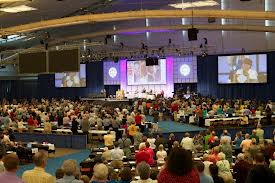
A picture of the assembly of commissioners to the 221st General Assembly in Detroit Michigan.

This blog on denominational issues requires a brief history of its purpose.

Prior to June of 2014 and the 221st General Assembly, the pastoral staff of First Presbyterian was engaged with our local Jewish Rabbis regarding the upcoming General Assembly.  There was a great deal of anticipation regarding the PCUSA’s decisions at the Assembly.

The conversations continued following the assembly.  First Presbyterian Church of Waco met as a congregation in late June of 2014 to debrief the assembly.  Additionally, the pastoral staff hosted one other small group gathering.  We  met with local Jewish brothers and sisters and interested members of the congregation.  Finally, as individuals requested private appointments, we honored those also.    All of these were opportunities to share, what, was then, recent information from the 221st General Assembly.

The session of First Presbyterian took up the discussion in two of its meetings in the summer of 2014.  Though they took no formal action, they remain attuned.   Your leadership is ready to listen, learn and lead in a way that strengthens First Presbyterian.  Each stewardship season, there is the opportunity to make comments about what we hope for our local congregation in the coming year. A number of congregants took the opportunity to share their continued concern regarding denominational decisions.    Such consistent and long standing concerns certainly suggests that additional forums for conversation are necessary.

pc-biz.org is still a website where you can find voting history and rationale for the votes from the 221st General Assembly should that be helpful for you.

So, the vision for this blog and the four face-to-face conversations throughout February and March is to honor one another in the act of listening.  Perhaps in we can grow in our understanding together.  We appreciate your prayers as we move forward toward the Lenten season and the ultimate hope of our Christian community.

Leave a comment

Filed under Uncategorized